FAITH UNRAVELLED: WHY FOLLOWERS OF JESUS ARE BREAKING FREE
A Truth Beyond Tradition Feature
I. The Quiet Revolution Nobody Can Ignore Anymore
Something remarkable is happening across the Christian world ... not loudly, not with rebellion, not with rage, but with a slow, steady, seismic shift. You won't see it on mainstream news or hear about it in most pulpits, but if you spend any time on Reddit's r/exvangelical, listen to podcasts like "The Deconstructionists," or scroll through TikTok's #exvangelical hashtag, you'll feel it immediately. It's like watching a glacier move...imperceptible moment by moment, but undeniably reshaping the landscape.
Christians everywhere are breaking free. Not in dramatic exits with slammed doors and public denunciations, but quietly, often painfully, in the privacy of their own hearts and homes. They're the seminary student who can't reconcile biblical contradictions anymore. The mom who watched her church defend a politician who violated everything Jesus taught about love. The theology major who read the actual Hebrew text and realized "hell" was a mistranslation.
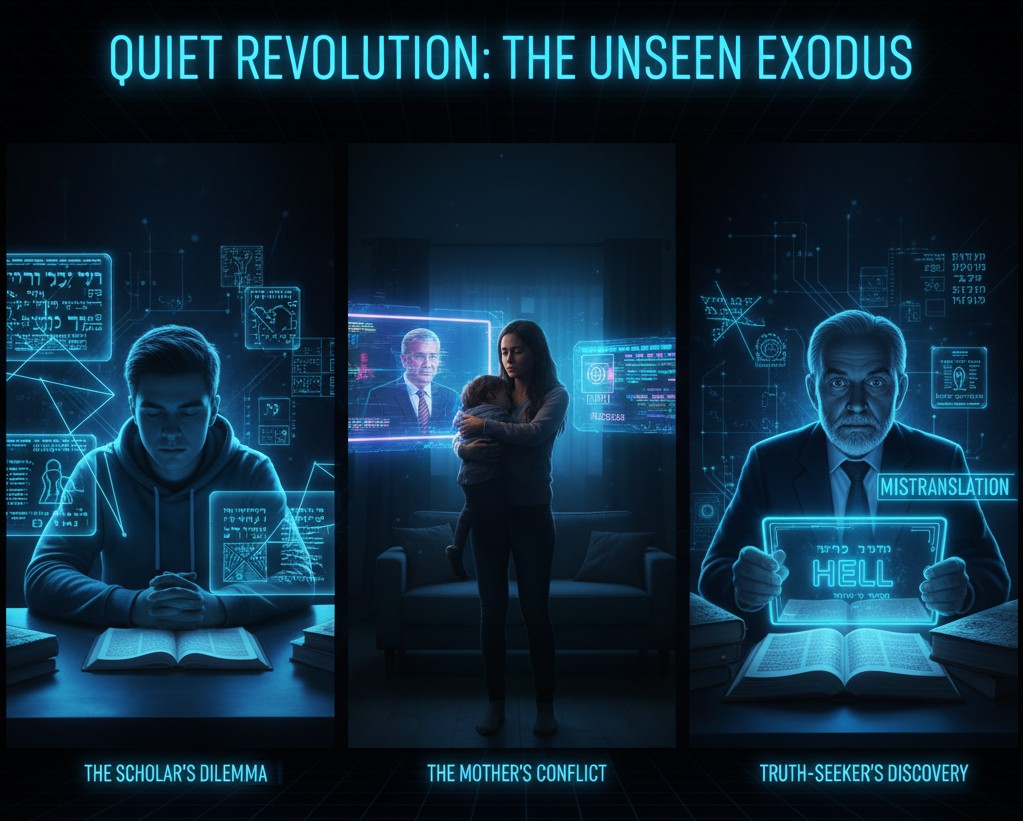
They're not breaking free from Jesus. That's crucial to understand. Most aren't rejecting the man who said "love your enemies" and "the Father judges no one." They're not walking away from the teacher who healed on the Sabbath and called out religious hypocrisy. They're holding onto Jesus tighter than ever-because they're finally seeing him clearly, without the layers of institutional interpretation that obscured his actual message.
Not from spirituality. In fact, many report feeling more connected to the divine after deconstructing. They're not becoming atheists-they're becoming mystics. They're discovering prayer that isn't transactional, worship that isn't performative, and faith that isn't fear-based. They're finding God in nature, in art, in community, in silence. The spiritual hunger remains; they're just no longer accepting the fast food version they were served.
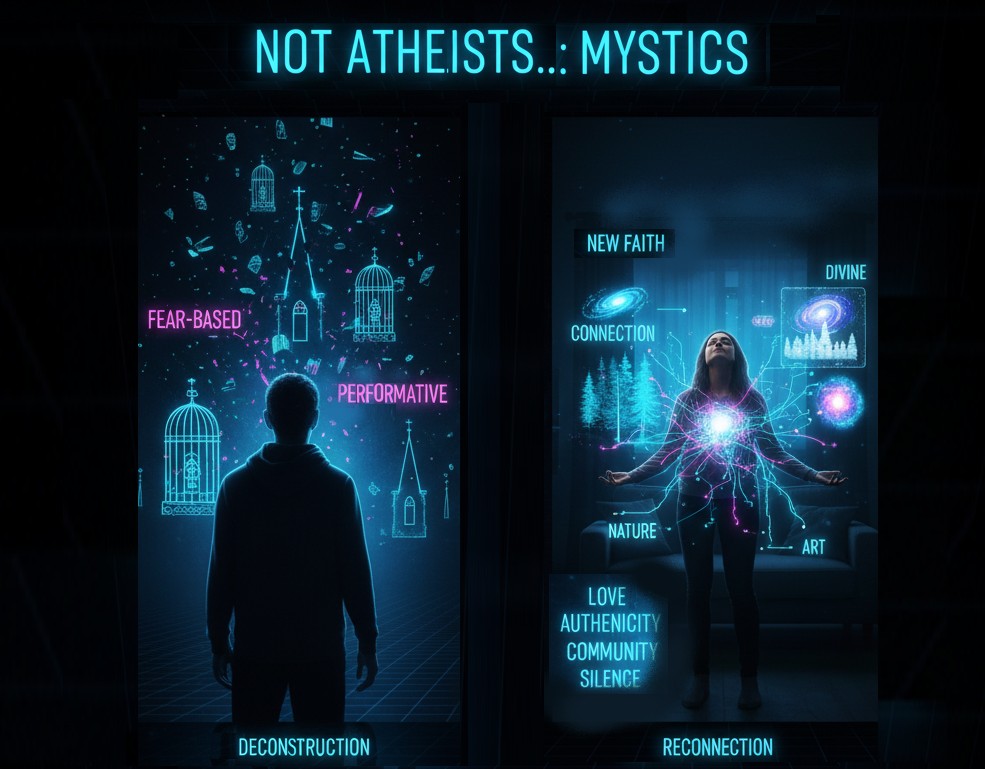
But they are escaping from:
- inherited dogmas...those beliefs passed down like family heirlooms, never questioned, never examined. Like the doctrine of original sin that made them feel broken from birth, or the idea that God needed blood to forgive, or the teaching that women should submit to men. These weren't conclusions they reached through study or experience; they were simply inherited, like eye color or last names.
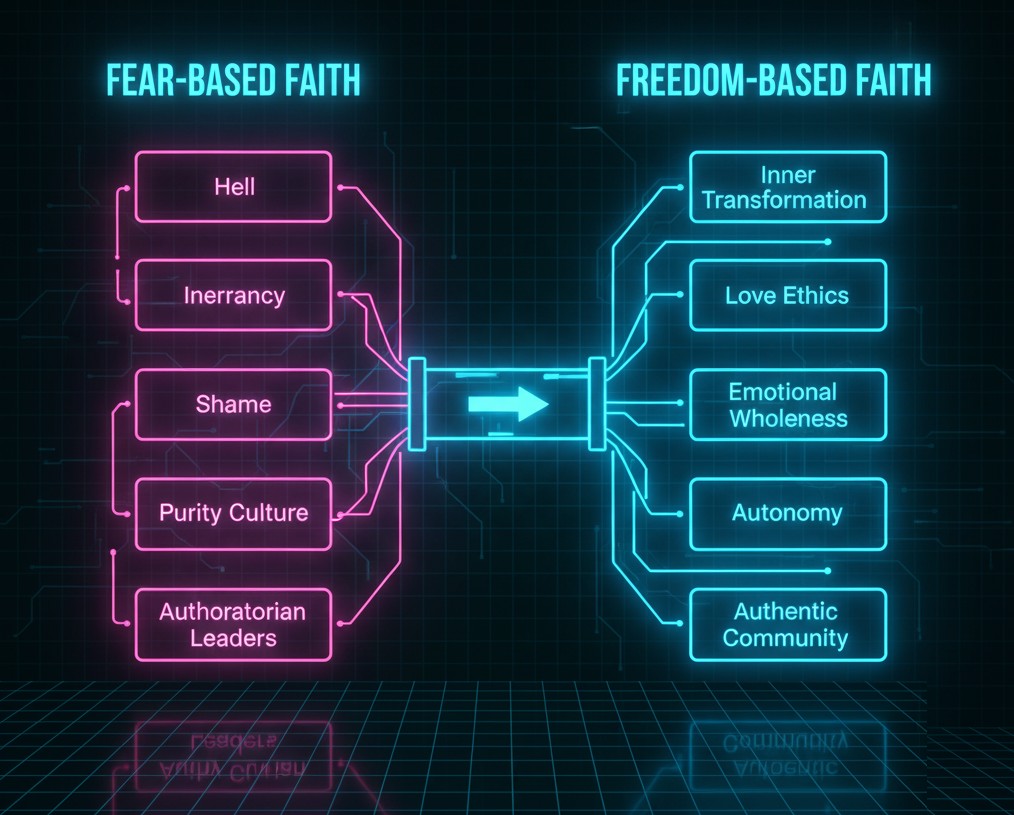
- fear-based doctrines...the entire theological framework built on "if you don't believe this, you'll burn forever." Think about it: how many decisions were made not from love, but from terror? How many people stayed in abusive churches because leaving meant hell? How many suppressed their authentic selves because authenticity was labeled "sin"? Fear became the primary motivator, and love became secondary. That's not faith-that's spiritual hostage-taking.
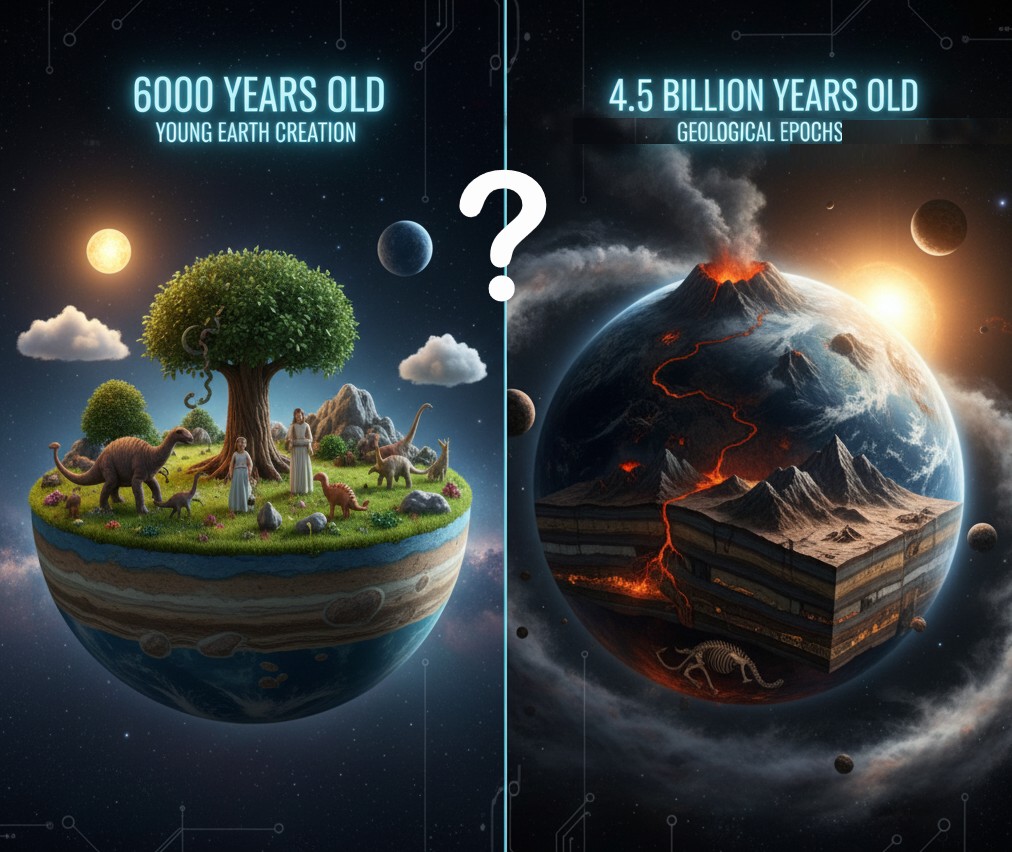
- rigid interpretations...the insistence that every word of the Bible must be literal, that there's only one "correct" way to read scripture, that questioning equals rebellion. But what happens when you read Genesis literally and then study actual geology? What happens when you read Paul's letters about women and then meet brilliant female theologians? The rigidity cracks. And when it does, everything shifts.
- authoritarian systems...the pastors who demand unquestioning obedience, the denominations that excommunicate questioners, the leaders who weaponize "spiritual authority" to silence dissent. We've all seen it: the megachurch pastor who falls from grace, the youth leader who abused their position, the elder board that protects abusers instead of victims. When authority becomes authoritarianism, trust dies.
- and belief structures that no longer match their moral, emotional, or intellectual experience. Here's what this looks like in real life: A nurse who's spent years caring for dying children can't worship a God who would send those children to hell. A scientist who can't pretend the earth is 6,000 years old. A parent who loves their LGBTQ+ child can't accept that God doesn't. Their lived experience-their actual experience of love, justice, and truth-conflicts with what they were told to believe. And they're choosing experience over indoctrination.
Research from Pew Research Center, along with countless surveys, Reddit threads, podcast episodes, and memoirs, shows a consistent pattern across thousands of testimonies: People are not leaving truth - they are leaving the claims that have no truth left in them. They're not abandoning reality; they're abandoning falsehoods. They're not rejecting evidence; they're rejecting assertions that contradict evidence. It's not a crisis of faith-it's a crisis of false faith.
They're discovering that what they were told was "faith" was often fear. Remember that knot in your stomach during altar calls? That wasn't the Holy Spirit-that was cortisol. The anxiety about whether you were "really saved"? That wasn't conviction-that was manipulation. The terror of hell that kept you compliant? That wasn't faith-that was spiritual abuse. Real faith, they're discovering, feels like peace, not panic. Like trust, not terror. Like love, not dread.
What they were told was "truth" was often tradition. Consider this: The doctrine of hell as eternal conscious torment? That wasn't in the original Hebrew or Greek texts-it was added through mistranslation and tradition. The idea that women can't lead? That was Paul's cultural context (or the writers who wrote in his name, to be more accurate), not Jesus' teaching. The belief that the Bible is inerrant? That's a relatively modern invention, not something the early church believed. So much of what was presented as "biblical truth" was actually just tradition-human interpretations, cultural biases, and institutional preferences masquerading as divine revelation.
What they were told was "God" was often a projection of ancient cultures and modern power. Think about it: The God who commanded genocide in the Old Testament? That sounds more like an ancient Near Eastern war deity than the Father Jesus revealed. The God who needs blood sacrifice to forgive? That sounds more like ancient pagan religion than unconditional love.

The God who endorses slavery and subjugation? That sounds more like human power structures than divine character. They're realizing that much of what they worshiped wasn't God at all-it was a projection, a reflection of the fears, prejudices, and power dynamics of the people who wrote and interpreted the texts.
This is not the death of Christianity. Despite what alarmist headlines suggest, Christianity isn't dying. Churches aren't emptying because people have lost interest in spirituality-they're emptying because people have found something better. Something more authentic. Something that actually matches the Jesus they read about in the Gospels.
It is the death of unquestioned Christianity. The version that demanded blind obedience, that punished questions, that weaponized fear, that protected abusers, that excluded the marginalized-that version is dying. And honestly? Good riddance. What's emerging in its place is something far more beautiful: a faith that can handle questions, that welcomes doubters, that centers love over fear, that protects the vulnerable, that includes everyone. A faith that's actually worthy of the name "Christian."
A new, liberated spirituality is emerging - and for many, this is the most honest faith they've ever known. They're finding communities online and in person where they can be fully themselves. They're discovering theologians and teachers who don't demand they check their brains at the door. They're experiencing a God who looks more like Jesus-compassionate, inclusive, non-violent, unconditionally loving. And for the first time in their lives, their faith feels real. Not performative. Not fear-based. Not inherited. But chosen. And that makes all the difference.
II. The Data Behind the Breakaway: The First Domino Always Matters
The latest Pew research highlights a universal dynamic called The Domino Effect. Picture a row of dominos standing upright-each one carefully positioned, each one supporting the next. The entire structure looks stable, unshakeable. But then one domino tips. Just one. And suddenly, they all start falling. That's exactly what's happening in Christianity right now.

Once one foundational belief loses credibility, the entire system begins to shift. It's not that people lose faith all at once. It's that one question leads to another, which leads to another, until the whole framework starts to wobble. You start by questioning hell, and suddenly you're questioning atonement. You start by questioning biblical inerrancy, and suddenly you're questioning everything. One crack becomes many. One doubt becomes a cascade.
Across thousands of stories-from Reddit threads to podcast interviews to memoir pages-the same early cracks appear again and again. It's almost like there's a script, a pattern that repeats itself across denominations, across countries, across generations. The details differ, but the trajectory is remarkably consistent. Someone encounters one of these "first dominoes," and their entire faith structure begins to shift.
The Most Common First Dominoes
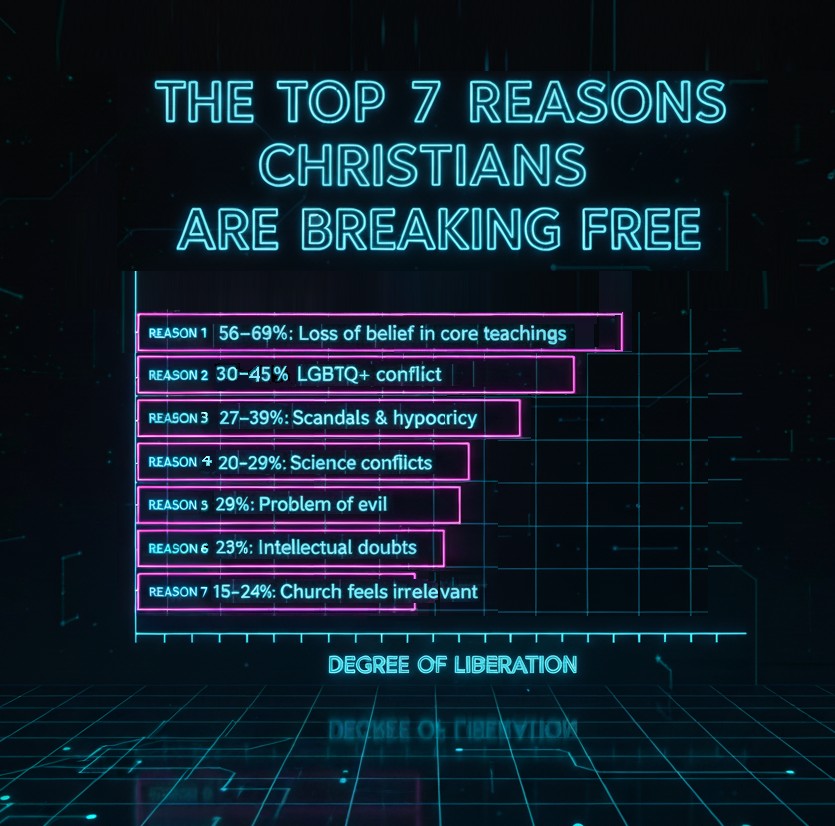
- Biblical contradictions-Like the person who notices that Matthew and Luke give completely different genealogies for Jesus, or that one Gospel says Jesus was crucified on Passover while another says the day before. Or they discover that the Bible says both "God never lies" and "God sent a lying spirit." Once you see one contradiction, you start seeing hundreds. And if the Bible isn't perfectly consistent, what else isn't true?
- Old Testament violence-The moment someone really reads those passages about God commanding genocide, about children being dashed against rocks, about entire cities being destroyed. They can't reconcile that with the Jesus who said "love your enemies" and "blessed are the peacemakers." If God commanded that kind of violence then, why did Jesus teach the opposite? The cognitive dissonance becomes unbearable. Most don't realize that Jesus called out the evil being everyone thought was God, the monster Yahweh, making it very clear this was not his Father. (see "Liberating Humanity: How Jesus Exposed The Evil God Of Moses And Warned Of Paul" in the book series below for a deeper discussion of this.)
- The doctrine of hell-Maybe they read a book about the original Greek words. Maybe they study what "Gehenna" actually meant. Maybe they just can't accept that a loving God would torture people forever. But once they question hell, they start questioning everything built on that foundation: original sin, atonement, salvation itself. If hell isn't real, what else isn't?
- Evolution vs a literal Genesis-The biology major who learns about DNA and realizes humans share 98% of our genetic code with chimpanzees. The geology student who understands that the Grand Canyon took millions of years to form. The astronomy enthusiast who knows the light from distant stars is billions of years old. They can't pretend the earth is 6,000 years old anymore. And if Genesis isn't literal, what else isn't?
- LGBTQ+ exclusion-The parent whose child comes out, and suddenly those "clobber verses" feel different. The youth group leader who realizes their best volunteers are gay, and they're the most Christ-like people they know. The person who finally admits their own orientation and can't reconcile it with a God who made them this way. Love for real people conflicts with abstract doctrine, and love wins.
- Church hypocrisy & scandals-The megachurch pastor caught in an affair. The youth leader who abused children. The elder board that protected abusers. The worship leader who lived a double life. When the people who claimed to represent God act nothing like God, trust erodes. And once trust is gone, everything else follows.
- Politics contaminating the pulpit-The Sunday morning when the pastor endorsed a candidate from the pulpit. The sermon that equated voting a certain way with faithfulness. The church that became a political action committee instead of a spiritual community. When faith becomes a political tool, it stops being faith. It becomes ideology. And people walk away.
- Divine hiddenness and unanswered suffering-The parent who prayed desperately for their child's healing, and the child died anyway. The person who begged God to stop their abuse, and it continued for years. The community that prayed for justice, and injustice prevailed. When God remains silent in the face of suffering, when prayers go unanswered, when evil seems to win-faith becomes harder to maintain. And some people can't maintain it anymore.
Each of these cracks undermines the assumed perfection of the system. Christianity was sold as a complete, perfect, infallible system-the Bible is perfect, the church is perfect, God's plan is perfect. But when you find one imperfection, you start looking for others. And you find them. Everywhere. And when perfection falls, so does certainty. You can't be certain about something that's clearly flawed. And when certainty falls, so does fear. You can't be afraid of something you're not certain about. When fear falls- people finally breathe. For the first time in years, maybe decades, they can take a full breath. They can think freely. They can question openly. They can be themselves authentically. And that feeling-that liberation-is intoxicating.
III. Four Breakout Paths: The Typologies of Deconstruction
While every deconstruction journey is unique, researchers and observers have identified four archetypes that describe almost every path people take. You might see yourself in one of these, or maybe you see pieces of yourself in several. That's normal. These aren't rigid categories-they're patterns that help us understand what's happening.
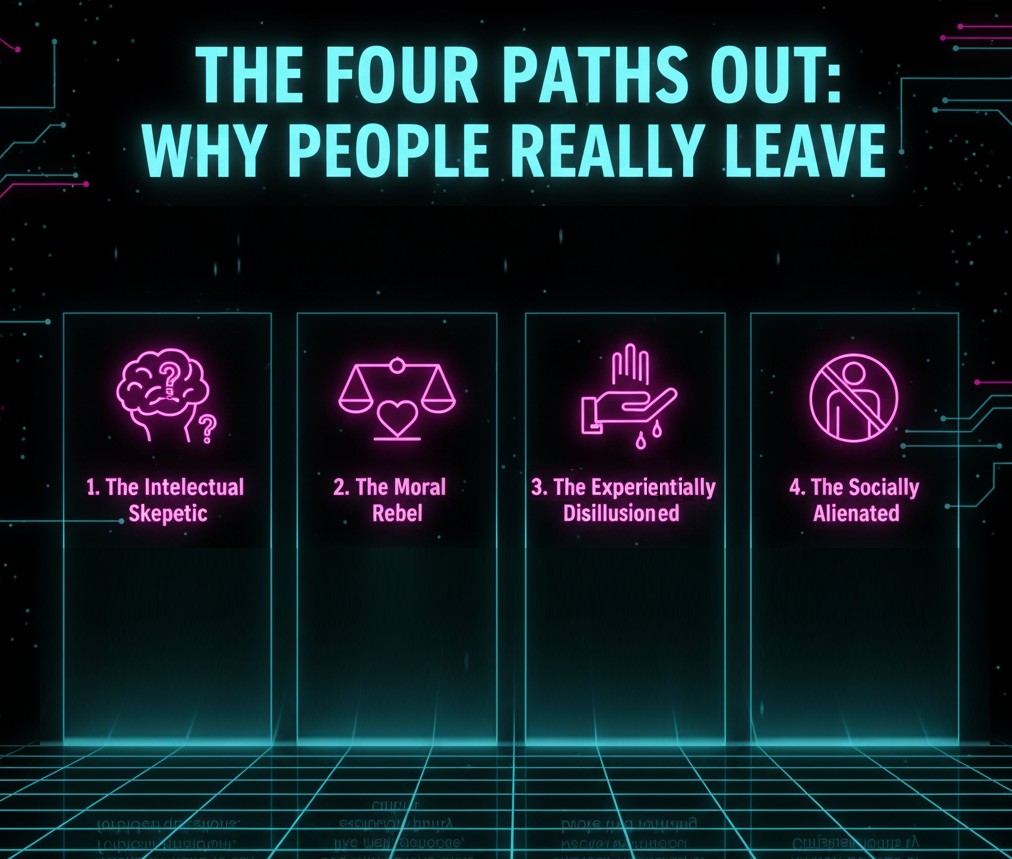
The Intellectual Skeptic
Triggered by contradictions, history, logic, science, and textual criticism. This is the seminary student who starts studying the original Greek and Hebrew texts and discovers mistranslations. The science teacher who can't reconcile evolution with a literal Genesis. The history major who learns about the Council of Nicaea and realizes doctrine was voted on by humans, not handed down from heaven. The Bible scholar who notices that Paul's letters contradict Jesus' teachings. For them, deconstruction isn't emotional-it's intellectual. Their brain simply can't accept what their faith demands they believe. They're not trying to be difficult; they're trying to be honest. And honesty requires them to question everything.
The Moral Rebel
Not rebellious-morally awake. They reject doctrines that violate conscience. This is the person who can't worship a God who would send their non-Christian friends to hell. The parent who loves their LGBTQ+ child and realizes that love is more important than doctrine. The person who studies the Old Testament and can't accept that genocide is ever justified. The Christian who sees their church exclude immigrants or defend racism and knows that's not what Jesus taught. Their conscience has evolved beyond their religion. They're not rejecting morality-they're embracing a higher morality, one that their faith can't accommodate. They're choosing love over law, compassion over condemnation, inclusion over exclusion.
The Experientially Disillusioned
Their wounds were inflicted inside Christianity itself. Abuse, hypocrisy, silence. This is the survivor of spiritual abuse who was told their abuser was "God's anointed." The person who was shamed for their mental health struggles, told they just needed "more faith." The person who was excommunicated for asking questions. The person who watched their church protect an abuser and silence the victim. The person who gave everything to their church and was discarded when they were no longer useful. Their faith didn't survive the institution that claimed to represent it. They're not leaving God-they're leaving the people who claimed to speak for God but acted nothing like God. Their wounds aren't from outside the faith; they're from inside it.
The Socially Alienated
Those pressured to conform until they finally break free from imposed identity. This is the person who was told their entire life who they should be-what they should wear, who they should date, what they should believe, how they should vote, what they should think. The person who was shamed for being different, for asking questions, for not fitting the mold. The person who realized they were living someone else's life, someone else's faith, someone else's values. They're not rejecting community-they're rejecting conformity. They're choosing authenticity over approval, self-discovery over self-denial, their own voice over the echo chamber. They're finally becoming who they actually are, instead of who they were told to be.
These are not "dangerous paths." That's what they're often called by those who fear deconstruction. But look at these descriptions-do they sound dangerous? They sound human. They sound like people trying to be honest, trying to be moral, trying to heal, trying to be themselves. That's not dangerous-that's healthy.
These are human paths. They're paths of integrity, of growth, of authenticity. They're paths that honor the mind, the conscience, the experience, the self. They're not paths away from God-they're paths toward a more honest relationship with God, with others, and with themselves. And that's not something to fear. That's something to celebrate.
IV. The Engine of Deconstruction: Moral Clarity, Not Moral Collapse
One of the most important findings to come out of the research is this, and it challenges everything we've been told about people who leave the faith:
People leave not because they become immoral, but because their morality grows beyond their religion.
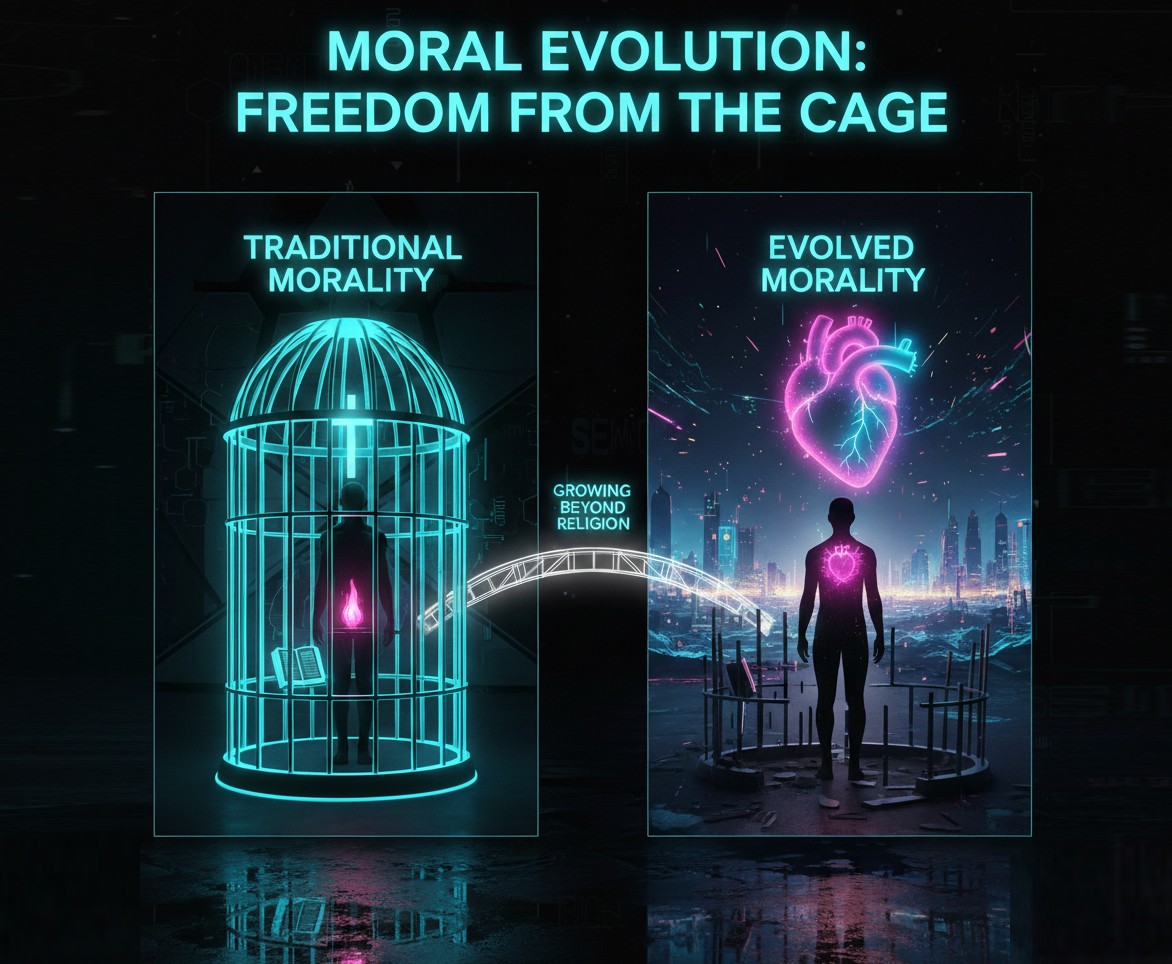
This is crucial to understand. The narrative we've been fed is that people deconstruct because they want to sin, because they're rebelling, because they're rejecting morality itself. But that's not what the data shows. The data shows something far more interesting: people are leaving because they've become MORE MORAL, NOT LESS. Their sense of JUSTICE has expanded. Their capacity for LOVE has grown. Their commitment to TRUTH has deepened. And their religion CAN'T KEEP UP.
Modern conscience cannot align with:
- Infinite torment for finite mistakes-The idea that a person could tell a lie at age 12 and deserve eternal torture. That a person who never heard the name "Jesus" deserves hell. That a loving God would create people knowing most would end up in eternal suffering. Modern moral sensibilities simply can't accept infinite punishment for finite actions. It violates every sense of justice, proportionality, and love we have.
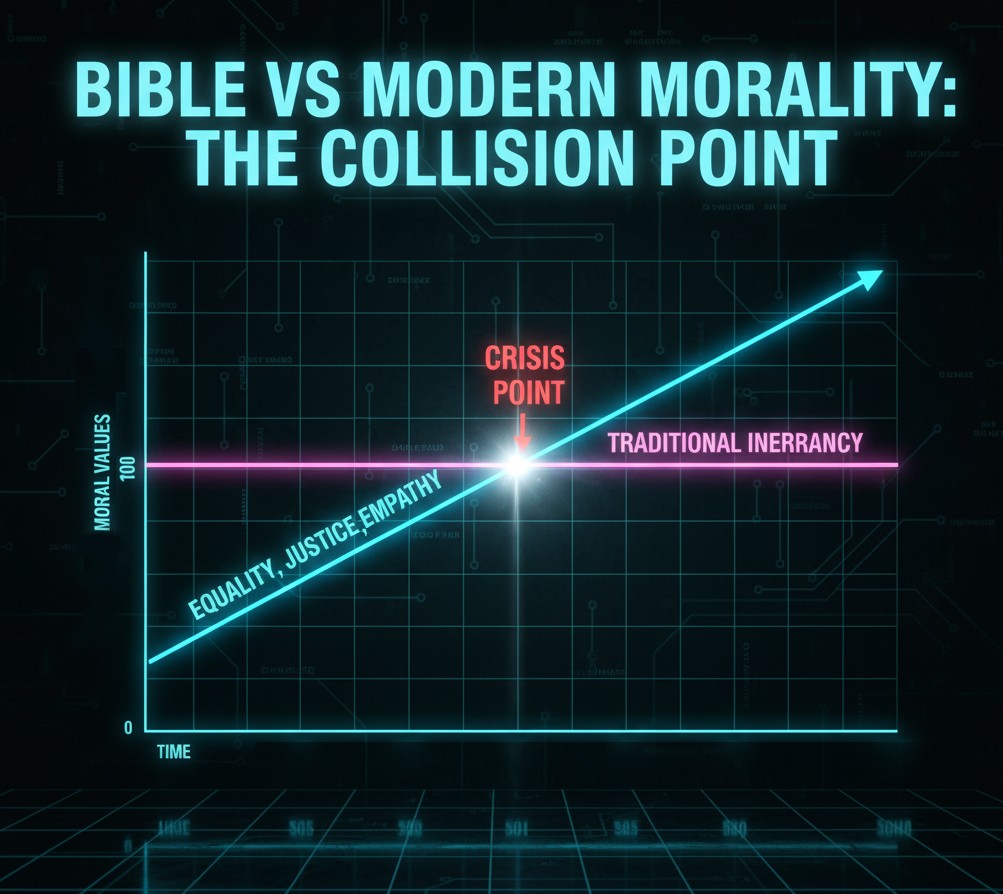
- Slavery, genocide, patriarchy, and divine violence-The Bible's endorsement of slavery. God's commands to commit genocide. Passages that tell women to submit to men. Stories of God killing thousands, even children. These aren't ancient cultural artifacts we can ignore-they're presented as divine commands, as examples of God's character. But modern morality has evolved. We know slavery is wrong. We know genocide is evil. We know equality is just. And we can't worship a God who doesn't share these values.
- LGBTQ+ exclusion-The teaching that same-sex love is inherently sinful, that transgender identity is a rejection of God's design, that LGBTQ+ people are "broken" or "disordered." But people know LGBTQ+ individuals. They're their friends, their family members, their neighbors. They're kind, loving, faithful people. And modern conscience can't accept that God would reject them for who they are. Love wins over doctrine.
- Purity culture trauma-The teaching that sexuality is dirty, that women's bodies are temptations, that modesty is a woman's responsibility, that "saving yourself" determines your worth. But we're learning about the damage this causes-the shame, the trauma, the broken relationships, the sexual dysfunction. Modern understanding of mental health and human development can't align with teachings that cause such harm.
- Authoritarian leadership-The model of pastor-as-king, of unquestioning obedience, of "touch not God's anointed." But we've seen where this leads-abuse, corruption, exploitation. Modern understanding of healthy relationships, boundaries, and accountability can't support systems that demand blind obedience and punish questions.
- Weaponization of scripture-Using Bible verses to control, to shame, to exclude, to harm. The way verses are cherry-picked to support predetermined conclusions. The way context is ignored to maintain power. Modern critical thinking skills can't accept this. People can see when scripture is being used as a weapon, not as a guide.
- Political extremism tied to Christianity-The fusion of faith with political ideology, the equating of voting a certain way with faithfulness, the use of Christianity to support policies that harm the vulnerable. Modern understanding of separation of church and state, of Jesus' apolitical message, can't reconcile faith with political power grabs.
These are not signs of rebellion. That's the old narrative-that people leave because they want to sin, because they're rejecting God's standards, because they're choosing the world over the Word. But look at this list. Do these sound like people rejecting morality? They sound like people whose morality has evolved beyond what their religion can accommodate.
They are signs of moral evolution. Human morality has progressed. We've learned that slavery is wrong. We've learned that equality is just. We've learned that love is more important than law. We've learned that inclusion is better than exclusion. And religion, in many cases, hasn't kept up. So people are choosing the higher morality-the one that aligns with love, justice, and truth-over the one that aligns with ancient texts and outdated doctrines. That's not collapse. That's growth.
V. Why Now? The Cultural Forces Accelerating the Exodus
Deconstruction isn't new-people have been questioning faith for centuries. But something is different now. The exodus is happening faster, wider, and more publicly than ever before. Why? Because there are seven systemic catalysts driving this global shift, and they're all converging at once:
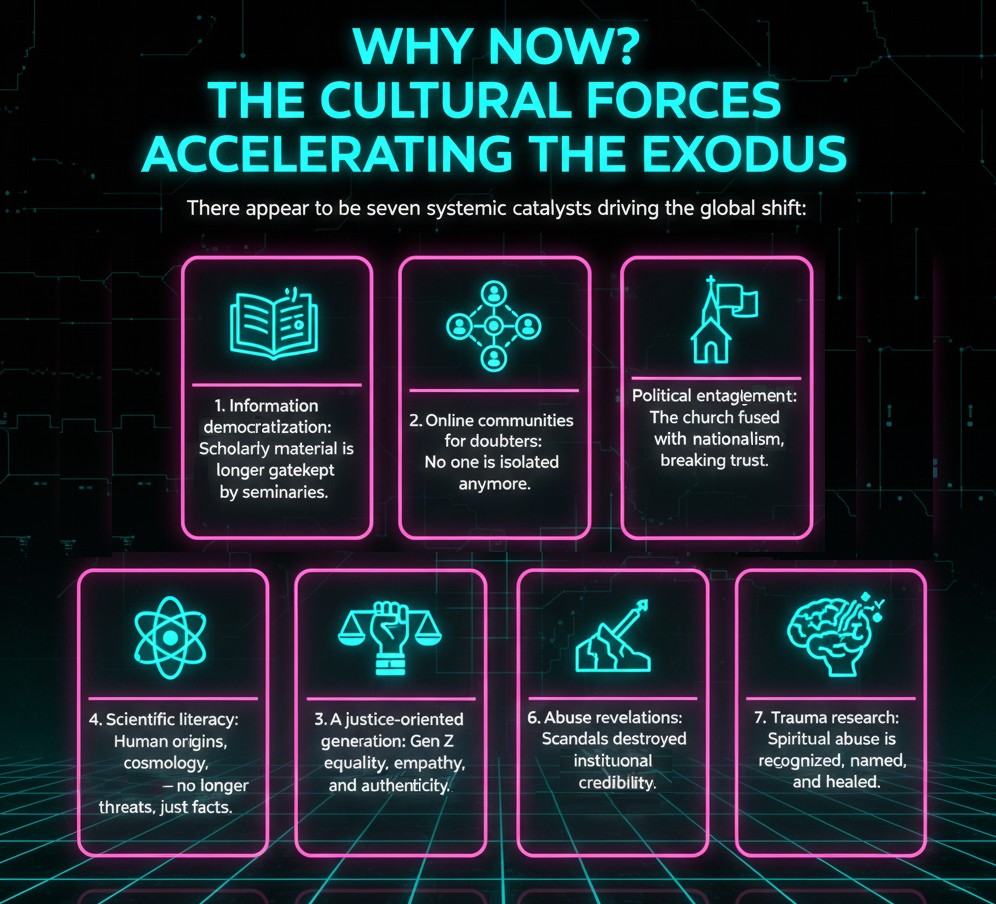
- Information democratization
Scholarly material is no longer gatekept by seminaries. Twenty years ago, if you wanted to understand biblical scholarship, you had to go to seminary. You had to pay thousands of dollars, move to a specific location, and accept whatever interpretation the institution taught. Now? You can watch lectures from world-renowned scholars on YouTube. You can read academic papers online. You can access ancient manuscripts digitally. You can learn Hebrew and Greek from apps. The gatekeepers have lost their gates. Information is free, accessible, and democratized. And once people have access to real scholarship, they can't unsee what they've learned. - Online communities for doubters
No one is isolated anymore. Before the internet, if you had doubts, you were alone. You might be the only person in your church, your town, maybe your entire region who was questioning. That isolation was crushing. But now? There are Reddit communities with hundreds of thousands of members. Facebook groups. Discord servers. Podcasts. TikTok hashtags. People are finding each other, sharing stories, supporting each other. They're realizing they're not crazy, not alone, not broken. They're part of a movement. And that changes everything. - A justice-oriented generation
Gen Z values equality, empathy, and authenticity. This generation was raised with diversity, inclusion, and social justice as core values. They've been taught to question authority, to stand up for the marginalized, to reject systems that harm people. So when they encounter Christianity that excludes LGBTQ+ people, that defends inequality, that protects abusers, that prioritizes power over people-they can't accept it. Their values don't align. And they're choosing their values over the religion that violates them. - Scientific literacy
Human origins, cosmology, evolution-no longer threats, just facts. We live in an age where scientific knowledge is more accessible than ever. Kids learn about evolution in elementary school. They understand that the universe is billions of years old. They know about DNA, genetics, geology, astronomy. And when they're told the earth is 6,000 years old, or that evolution is a lie, or that humans were created exactly as we are now-they know that's not true. They can't pretend otherwise. Science isn't attacking faith; it's just revealing what's actually true. And truth wins. - Political entanglement
The church fused with nationalism, breaking trust. In recent years, we've seen Christianity become almost indistinguishable from a particular political party. Pastors endorsing candidates from the pulpit. Churches becoming political action committees. Faith equated with voting a certain way. But Jesus was apolitical. He didn't endorse candidates. He didn't align with political power. He served the marginalized, not the powerful. When the church abandons that to chase political power, it loses its soul. And people walk away. - Abuse revelations
Scandals destroyed institutional credibility. We've seen it over and over: megachurch pastors caught in affairs, youth leaders abusing children, churches protecting abusers instead of victims. The #MeToo movement exposed abuse in churches. Documentaries revealed cover-ups. Survivors found their voices. And each revelation eroded trust. When the people who claim to represent God act nothing like God, when institutions protect abusers instead of victims, credibility dies. And once credibility is gone, everything else follows. - Trauma research
Spiritual abuse is now recognized, named, and healed. We're finally understanding the damage that religious trauma causes. We have language for it now: spiritual abuse, religious trauma, purity culture damage. We have therapists who specialize in it. We have support groups. We have research showing the long-term effects. People are realizing that what they experienced wasn't normal, wasn't healthy, wasn't God's will. It was abuse. And they're healing. And part of that healing is leaving the systems that harmed them.
This is not a small shift. This isn't a few people leaving here and there. This is a mass movement. Churches are emptying. Denominations are shrinking. Entire institutions are being questioned. The landscape of American Christianity is being reshaped in real-time.
This is a civilizational turning point. We're witnessing the end of one era and the beginning of another. The era of unquestioned authority, of blind faith, of fear-based religion-that's ending. What's beginning is something new: an era of authentic faith, of chosen spirituality, of love-based community. And that's not something to fear. That's something to embrace.
VI. A New Spiritual Landscape: What People Want Instead
Contrary to old narratives, most deconstructing Christians aren't running toward nihilism. The fear-mongering says they're becoming atheists, abandoning all values, rejecting everything. But that's not what's happening. They're not running away from something-they're running toward something. Something better. Something more authentic. Something that actually works.
They want:
- A God who matches Jesus, not Yahweh-They've read the Old Testament and seen the violence, the genocide, the commands that violate everything Jesus taught. They've read the Gospels and seen Jesus' radical love, his inclusion, his non-violence. And they're choosing the God Jesus revealed-the Father who judges no one, who loves unconditionally, who heals instead of harms. They want the God of the Sermon on the Mount, not the God of the conquest narratives.
- Spirituality without fear-They're done with faith that's built on terror. They want prayer that's about connection, not transaction. Worship that's about gratitude, not performance. Faith that's about trust, not compliance. They want to experience the divine from a place of love, not dread. They want spirituality that feels like coming home, not like walking on eggshells.
- Communities without control-They want relationships based on mutual respect, not hierarchy. Leadership that serves, not dominates. Communities that welcome questions, not silence them. They want to be part of something, not controlled by something. They want belonging, not conformity.
- Scripture without literalism-They want to engage with the Bible as the complex, beautiful, human-and-divine text it is. They want to understand context, history, genre, translation. They want to read it with their minds engaged, not checked at the door. They want to appreciate its wisdom without pretending every word is literally true. They want interpretation, not indoctrination.
- Morality without authoritarianism-They want ethics that come from love and wisdom, not from commands and threats. They want to do good because it's good, not because they'll be punished if they don't. They want morality that's chosen, not coerced. They want to be good people, not obedient robots.
- Identity without shame-They want to be themselves fully, authentically, without apology. They want to embrace their sexuality, their gender, their personality, their gifts, their flaws-all of it. They're done with shame-based identity. They want to know they're loved as they are, not as they should be. They want acceptance, not conditional approval.
- Truth without manipulation-They want honesty, even when it's uncomfortable. They want to know the real history, the real scholarship, the real complexity. They're done with simplified answers to complex questions. They want truth that can handle questions, that welcomes doubt, that doesn't fall apart under scrutiny. They want integrity, not certainty.
This is not deconstruction. That word implies tearing down, destroying, negating. But look at this list-do these sound like people tearing things down? They sound like people building something. Something new. Something better.
This is reconstruction. They're not abandoning faith-they're rebuilding it. They're not rejecting spirituality-they're refining it. They're not walking away from community-they're creating new forms of it. They're taking what works, leaving what doesn't, and building something authentic. Something that honors their mind, their heart, their experience, their values. Something that's actually worth believing in.
VII. The Stories Behind the Statistics
Behind every statistic, every survey number, every research finding, there are real people with real stories. And these personal stories coming to the fore are escalating-they're being shared on podcasts, in memoirs, on social media, in support groups. They're no longer hidden. They're no longer silenced. They're being told, and they're changing everything.
- The intellectual who lost biblical inerrancy and watched everything shift. Maybe they were a Bible college student who started studying textual criticism. Maybe they discovered that the story of the woman caught in adultery wasn't in the earliest manuscripts. Maybe they learned that the ending of Mark was added later. And once they realized the Bible wasn't perfectly preserved, they started questioning everything built on that foundation. If the Bible has errors, what else does? If it's not inerrant, what is it? And suddenly, the whole system started to shift.
- The moral thinker who could no longer worship a God who damns billions. They thought about their friends who weren't Christians-good, kind, loving people. They thought about people in other religions who were more Christ-like than many Christians they knew. They thought about children who died before they could "accept Jesus." And they realized: if God sends these people to hell, God is not good. And if God is not good, why worship? Their conscience couldn't accept a God who would do that. So they walked away.
- The abuse survivor who realized "spiritual authority" was spiritual trauma. They were told to submit, to obey, to trust. They were told their abuser was "God's anointed," that questioning was rebellion, that leaving was sin. But they were being harmed. And when they finally found the courage to leave, they realized: that wasn't God. That was abuse. That wasn't authority. That was control. And they're not leaving God-they're leaving the people who used God to harm them.
- The politically disillusioned believer who saw Jesus hijacked by ideology. They watched their church become a political action committee. They heard sermons that equated voting a certain way with faithfulness. They saw Jesus' name used to support policies that harmed the vulnerable. And they realized: this isn't what Jesus taught. Jesus was apolitical. Jesus served the marginalized. Jesus loved enemies. And when the church abandoned that to chase political power, they abandoned the church.
These aren't fringe stories. These aren't isolated incidents. These aren't exceptions. These are happening everywhere. In every denomination. In every region. Across every demographic. They're not rare-they're common.
They are the new normal. This is what's happening now. This is the reality of contemporary Christianity. People are leaving. Not because they're weak. Not because they're sinful. Not because they're deceived. But because they're honest. Because they're moral. Because they're healing. Because they're choosing authenticity over conformity, truth over tradition, love over law.
People are not leaving Christianity because they lack faith. That's the old narrative-that people leave because they don't have enough faith, because they're not committed enough, because they're not strong enough. But that's not true. Many of the people leaving are the most faithful, the most committed, the most dedicated. They're the ones who took it seriously, who studied it deeply, who lived it fully. And that's exactly why they're leaving-because they took it seriously enough to see its flaws.
They are leaving because the system lacked integrity. The system that claimed to be perfect but had flaws. The system that claimed to be loving but excluded people. The system that claimed to be truthful but hid information. The system that claimed to protect but enabled abuse. The system lacked integrity. And people of integrity can't stay in a system that lacks it. So they're leaving. Not because they're faithless. Because they're faithful-to truth, to love, to justice, to authenticity. And that faithfulness requires them to leave.
VIII. So Why Are Christians Breaking Free?
A summary in one breath-the reasons people are leaving, expanded:
Because the old answers don't answer anymore. "Just have faith" doesn't work when your questions are legitimate. "The Bible says so" doesn't work when the Bible contradicts itself. "God's ways are higher" doesn't work when God's ways seem cruel. The pat answers, the clichés, the platitudes-they're not enough anymore. People need real answers, and the old ones aren't cutting it.
Because doctrines built on fear crumble under love. When you experience real love-unconditional, accepting, freeing-fear-based theology starts to feel wrong. When you love someone who's "supposed" to go to hell, the doctrine of hell starts to feel cruel. When you experience grace that's actually gracious, the idea that God needs blood to forgive starts to feel barbaric. Love exposes fear for what it is: manipulation, not truth.
Because information set them free. Once you learn the real history, the real scholarship, the real complexity-you can't unlearn it. Once you understand that "hell" was mistranslated, that the Bible has contradictions, that doctrine was voted on by humans-you can't pretend otherwise. Information is liberating. Ignorance was the prison. Knowledge is the key.
Because morality evolved. Human morality has progressed. We know slavery is wrong. We know equality is just. We know inclusion is better than exclusion. We know love is more important than law. And when religion hasn't kept up with that evolution, when it still defends things we know are wrong, people choose the higher morality. They choose love over law, justice over judgment, inclusion over exclusion.
Because the church lost credibility. When pastors fall, when leaders abuse, when institutions protect abusers, when churches become political tools-credibility dies. And once credibility is gone, trust is gone. And once trust is gone, everything else follows. People can't follow leaders they don't trust. They can't believe institutions that have lied. They can't stay in communities that have harmed.
Because the Bible contradicted itself. Once you see one contradiction, you see hundreds. Once you realize the Bible isn't perfectly consistent, you start questioning everything built on that consistency. If the Bible contradicts itself, what else isn't true? If it's not inerrant, what is it? And the whole foundation starts to shift.
Because God remained silent in their suffering. They prayed, they begged, they cried out-and God was silent. Their child died anyway. Their abuse continued. Their prayers went unanswered. And they realized: either God doesn't care, or God can't help, or God isn't there. And silence in the face of suffering is its own answer.
Because Jesus looked nothing like the institutional religion built in His name. They read the Gospels and saw radical love, inclusion, non-violence, service to the marginalized. Then they looked at the church and saw exclusion, judgment, political power, service to the powerful. The disconnect was too great. They chose Jesus over the institution that claimed to represent him.
Because once you pull one thread, the whole garment of certainty unravels. You start by questioning one thing-maybe hell, maybe biblical inerrancy, maybe a particular doctrine. But questions lead to more questions. Doubts lead to more doubts. One thread becomes many. And before you know it, the whole garment-the whole system of certainty-is unraveling. And you realize: maybe certainty was an illusion all along.
Because escaping fear feels like resurrection. For years, maybe decades, they lived in fear. Fear of hell, fear of judgment, fear of being wrong, fear of disappointing God. And when that fear finally lifts-when they realize they don't have to be afraid anymore-it feels like coming back to life. It feels like resurrection. It feels like freedom. And once you taste that freedom, you can't go back to fear.
Christians are not losing faith. They're not abandoning spirituality. They're not rejecting God. They're not becoming immoral. They're doing something far more radical: they're choosing authenticity over conformity, truth over tradition, love over law.
They are losing illusions. The illusion that the Bible is perfectly consistent. The illusion that the church is always right. The illusion that fear is faith. The illusion that certainty is possible. The illusion that God is exactly who they were told God is. They're losing these illusions, and in losing them, they're finding something real.
This is not the end of belief. Despite what the alarmists say, faith isn't dying. It's being reborn. It's being refined. It's being rebuilt. What's ending is false faith-faith based on fear, on certainty, on conformity. What's beginning is authentic faith-faith based on love, on questions, on choice.
This is its rebirth. Christianity is being reborn. Not as an institution that demands obedience, but as a movement that invites authenticity. Not as a system that punishes questions, but as a community that welcomes them. Not as a religion built on fear, but as a spirituality built on love. And that rebirth? That's something to celebrate. That's something to embrace. That's something to be part of.