God and Judgment: How Jesus Shattered Everything You Were Taught About Hell, Atonement and Love
What if everything you've been taught about hell is wrong? For a large part of my life, I believed what preachers had regularly told me: "Hell is real."
Eternal torment was never a place of fire, but a mistranslation born from fear. The Father Jesus revealed doesn't judge anyone ... not now, not ever.
Here's what I know with 100% certainty: The gospel you've heard isn't good news at all ... it's cosmic blackmail!

This isn't a gentle theological discussion. This is a seismic shift that challenges everything you thought you knew about God's character, judgment, and love. Because if Jesus never taught eternal torment, if the Father judges no one, if forgiveness doesn't require blood ... then the implications for what you may have believed your entire life are significant. In a good way, believe it or not!
The Question That Exposes the Absurdity
Imagine sitting in a living room, discussing theology. Someone asks a simple question: "Are there any babies in hell?"
The answer comes quickly: "Definitely not." Everyone looks horrified at the very suggestion. But then comes the follow-up: "Are we not all born sinners? Doesn't the Bible say everyone is born in sin?"
This is where the doctrine of eternal torment collapses under its own weight. If eternal conscious torment is real, then killing babies before they can sin would be merciful—robbing Satan of souls. If we truly believed what we say we do, we'd march into neonatal wards with semiautomatic weapons and send every baby to heaven before they could sin. Hell would be emptier, Satan poorer, and God richer.

This isn't logic. This is the collapse of fear-based theology. But Jesus never preached blackmail. He preached love that refuses to fail.
The Word That Never Existed
Here's something that may surprise you: the word "hell" as we understand it—a place of eternal fiery torment—never existed in the original languages of the Bible. It was invented by translators who flattened three completely different words into one convenient, terrifying concept.
The Hebrew word Sheol simply meant "the grave"—a neutral place where everyone goes when they die. It wasn't a place of punishment. It wasn't a place of reward. It was just death. The Psalms describe Sheol as a place of silence, rest, and equality—where both the righteous and wicked end up. That's why a number of Old Testament figures are quoted as saying that they are longing to go to Sheol. For example, Job expresses this longing: "Oh, that You would hide me in Sheol, that You would conceal me until Your wrath returns" (Job 14:13).

The Greek word Hades was simply the Greek equivalent of Sheol—the grave, the place of the dead. It came from Greek mythology, but in the New Testament, it was used neutrally to mean death itself. It wasn't understood as a place of eternal torment but as a neutral state of death.
Then there's Gehenna—a real valley outside Jerusalem. In Jesus' time, it was a smoldering waste dump where fires burned to consume the city's refuse. When Jesus warned about being "in danger of Gehenna," His hearers didn't picture an underworld dungeon. They pictured that valley: smoldering, foul, and visible from their city walls. He was talking about consequences on earth—the spiritual rot that would consume the nation if it clung to hypocrisy and violence.
The Mistranslation That Changed Everything
Centuries later, translators faced a problem. Greek manuscripts used three different words—Hades, Gehenna, and Tartarus—each with distinct meanings. The Latin Vulgate flattened them into infernum, and English translators followed suit with a single, convenient word: HELL.
One word to rule them all. One word to terrify them all. It was efficient, and disastrous. The valley outside Jerusalem, the neutral grave, and a Greek mythological prison were suddenly merged into one eternal furnace. The misstep stuck becausefear sells. It builds cathedrals faster than compassion does.
But the mistranslations didn't stop there. The Greek word aionios—commonly translated as "eternal"—actually means "age-lasting" or "pertaining to an age." When Jesus spoke of "eternal" punishment, He was referring to the consequences of the coming end of the Jewish age—the destruction of the temple in AD 70—not everlasting torment in an afterlife. The same word is used for "eternal life," which Jesus said was knowing the Father—a present reality, not just a future one.
The Father Who Judges No One
There are two voices echoing through Scripture. One thunders, "Slay every man, woman, and child." The other whispers,"Father, forgive them. They don't know what they're doing."
Jesus said something that should have ended the debate forever: "The Father judges no one."
"The Father judges no one." — John 5:22
No one. Not now. Not later. Not ever. Every Old Testament judgment, every massacre claimed in God's name—Jesus was pulling the curtain back on the human projection behind it. The Father doesn't judge. The Father doesn't condemn. The Father doesn't need vengeance.

When Jesus said, "If you've seen Me, you've seen the Father," He wasn't adding another voice to the chorus. He was replacing all the others. The character of God is not a collage of contradictory verses. It's a single face—the face Jesus revealed.If anything in Scripture contradicts the compassion of Jesus, it doesn't reveal God: it reveals our misunderstanding of Him.
The Fire That Purifies, Not Tortures
When Jesus spoke of fire, it was always cleansing—the fire that purifies gold, the baptism of fire that transforms hearts, the light that exposes darkness. He warned of Gehenna—that real waste dump outside Jerusalem where fires smoldered. He was talking about spiritual rot consuming the nation, not eternal punishment.
"I came to bring fire on the earth, and how I wish it were already kindled!" — Luke 12:49
The only fire Jesus ever promised: the fire of reality. The fire of truth that consumes lies. The fire of love that burns clean. Not the fire of punishment, but the fire of awakening. The real hellfire wasn't beneath the earth. It was the fear inside believers: the inherited terror that made them doubt love itself. For centuries, that inner fire has done far more damage than any literal flame could.
Jesus burned down the altar of retribution. He burned the ledger that kept track of sins and sacrifices. He turned the word "repent" from self-loathing into awakening. He turned judgment from damnation into healing. He turned obedience from fear into love.
Atonement Without Blood
Here's where it gets revolutionary: Jesus didn't need a cross to forgive. He forgave freely. Unasked. On the spot. No rituals. No intermediaries. No transaction. From the cross itself, He cried: "Father, forgive them, for they don't know what they're doing."
Jesus forgave a paralyzed man before a single drop of blood was spilled. He forgave prostitutes, tax collectors, and His executioners—all without requiring payment, sacrifice, or atonement. Forgiveness wasn't something that needed to be purchased. It was something that flowed naturally from love.

But then came Paul, who told us forgiveness only flows when you believe in blood. "Without the shedding of blood, there is no forgiveness" (Hebrews 9:22). Really? Because Jesus forgave before a single drop was spilled. Paul hijacked Jesus' story and twisted it into a theological death cult. He took the blood sacrifice system Jesus rejected and made it central to Christianity.
The Father doesn't need blood. Doesn't need sacrifice. Doesn't need atonement. He simply forgives. Unconditionally. Without terms. Without conditions. Without wrath. The cross wasn't divine wrath unleashed. It was divine innocence revealed. Love stood there, bleeding between two thieves, while the old religion mocked. But Love doesn't come down. Love stays. Love endures every accusation, absorbs every sin, and turns the weapon of fear into a bridge of forgiveness.

The Love That Refuses to Fail
For centuries, religion taught us to tremble before God. To treat Him as an unpredictable monarch, easily offended and impossible to please. We built entire systems around managing His moods, trying to stay on His good side. We forgot that Jesus came to show us the good side had no bad side at all.
He walked through villages, touching the untouchable, forgiving without permission, healing without prerequisites. He didn't act like a servant of wrath. He acted like a Son of love, revealing a Father who has no interest in vengeance, only reunion.
The most repeated statement in the Bible is not about judgment; it is about mercy that endures forever. Forever is a long time to keep forgiving, but apparently that's what the Father does. We keep wandering, but He keeps coming. We build doctrines of separation, but He keeps bridging them. We light our own little hells of guilt and resentment, and He walks right into the fire to sit with us until we can see His face again.
Sometimes I picture Him like a parent sitting outside a locked bathroom door while a teenager cries inside. He does not shout, "Come out or else." He waits, listening, ready to hold them the second the door opens. That is not weakness. That is what love looks like when it grows up.
The Scandal of Unconditional Love
The idea that God loves everyone equally sounds lovely in theory until you apply it to the people we cannot stand. Serial killers. Dictators. Abusers. We want a cutoff line. Surely love has a limit.
But Jesus kept crossing lines until there were none left. He ate with tax collectors, healed servants of Roman soldiers, pardoned prostitutes, and forgave His executioners. He didn't act like love had conditions. He acted like love was the only condition.
You stop negotiating and start trusting. You stop groveling and start resting. You stop trying to deserve love and start daring to believe it has been chasing you all along. That is the moment the cage opens. That is the sound of hell collapsing.
Universal Reconciliation: The Hope That Won't Die
If the Father judges no one, if love refuses to fail, if forgiveness doesn't require blood—then what happens to everyone? The breathtaking hope is universal reconciliation: a divine plan to heal all creation.
This isn't universalism in the sense that everyone gets a free pass. It's the recognition that love is stronger than sin, that restoration is more powerful than retribution, that healing is more persistent than destruction. One day, when this story is finished, and all the illusions have burned away, the universe will echo with a single truth: No one was ever outside the reach of love.
Every tear will be wiped away, not by decree, but by recognition. Every scar will become a story of grace. Every lost heart will finally realize it was never truly lost. Love wins. Always. Not because we deserve it, but because it cannot do anything else.It is who God is.
Once love wins in you, it refuses to lose anywhere else. Love always expands. It moves from you to the person you judged, to the stranger you avoided, to the enemy you feared. And suddenly you understand why Jesus called His kingdom a seed. It grows quietly, steadily, beneath the surface of everything.
The Liberation From Fear
It takes a long time to unlearn fear. It clings to the corners of the soul like smoke after a fire. Even when the flames are gone, the smell remains. But something stronger is rising now. A different kind of fire. Not the fire of punishment, but the fire of awakening. The fire of love that burns clean.
When you realize the Father doesn't judge, doesn't condemn, doesn't need blood—everything shifts. You stop labeling people as saved or unsaved, worthy or unworthy, clean or unclean. Because once love wins in you, it refuses to lose anywhere else.
You experience tremendous psychological healing—freedom from distressing dreams and guilt. You find authentic relationships without the pressure to convert everyone you meet. You stop negotiating with God and start trusting—stop groveling and start resting.
You were never separated. Never unloved. Never needed to earn what was already yours.
The real hellfire wasn't beneath the earth. It was the fear inside believers: the inherited terror that made them doubt love itself. For centuries, that inner fire has done far more damage than any literal flame could. But now you know the truth. The Father judges no one. Love refuses to fail. And hell—as you understood it—was never real.
The Choice Before You
You have a choice. You can continue believing in a God who judges, condemns, and requires blood sacrifice. You can continue living in fear of eternal torment that was built on mistranslations and fear-based control. Or you can follow Jesus to the Father He revealed—the one who judges no one, who loves without conditions, who forgives without payment.
This isn't about abandoning faith. It's about finding the real thing. It's about discovering the Father Jesus knew—the one who doesn't need to be appeased, who doesn't need blood, who doesn't need your fear.
Jesus left us with no safe middle ground. Either God is love, or God is a monster with good PR. There's no third option. If we claim to follow Jesus but still worship the punishing god He came to expose, we've missed the point of His teachings entirely.
Love wins. Always.
Not because we deserve it, but because it cannot do anything else. It is who God is. The journey starts here. The truth sets you free.
Ready to Go Deeper?
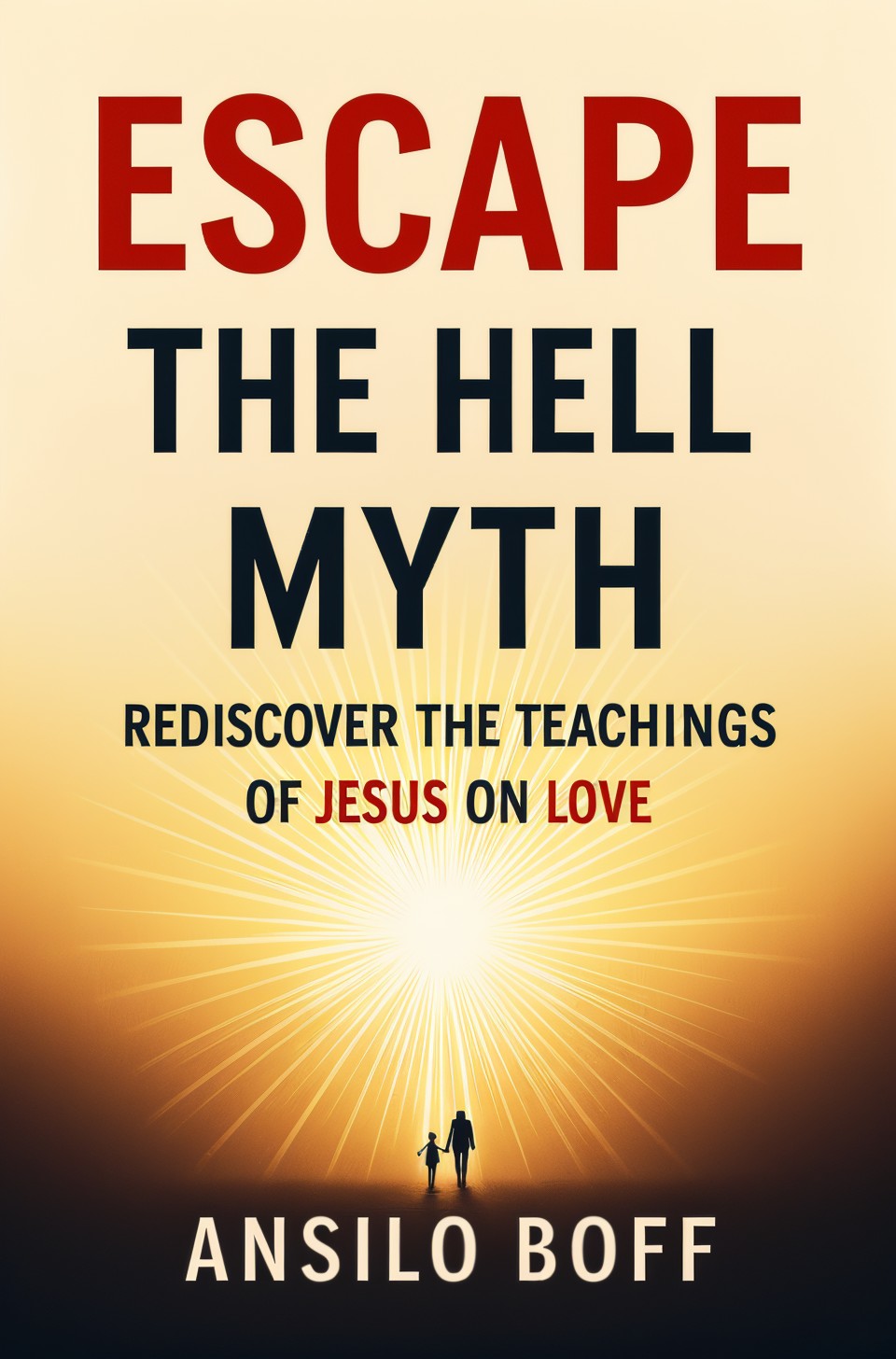
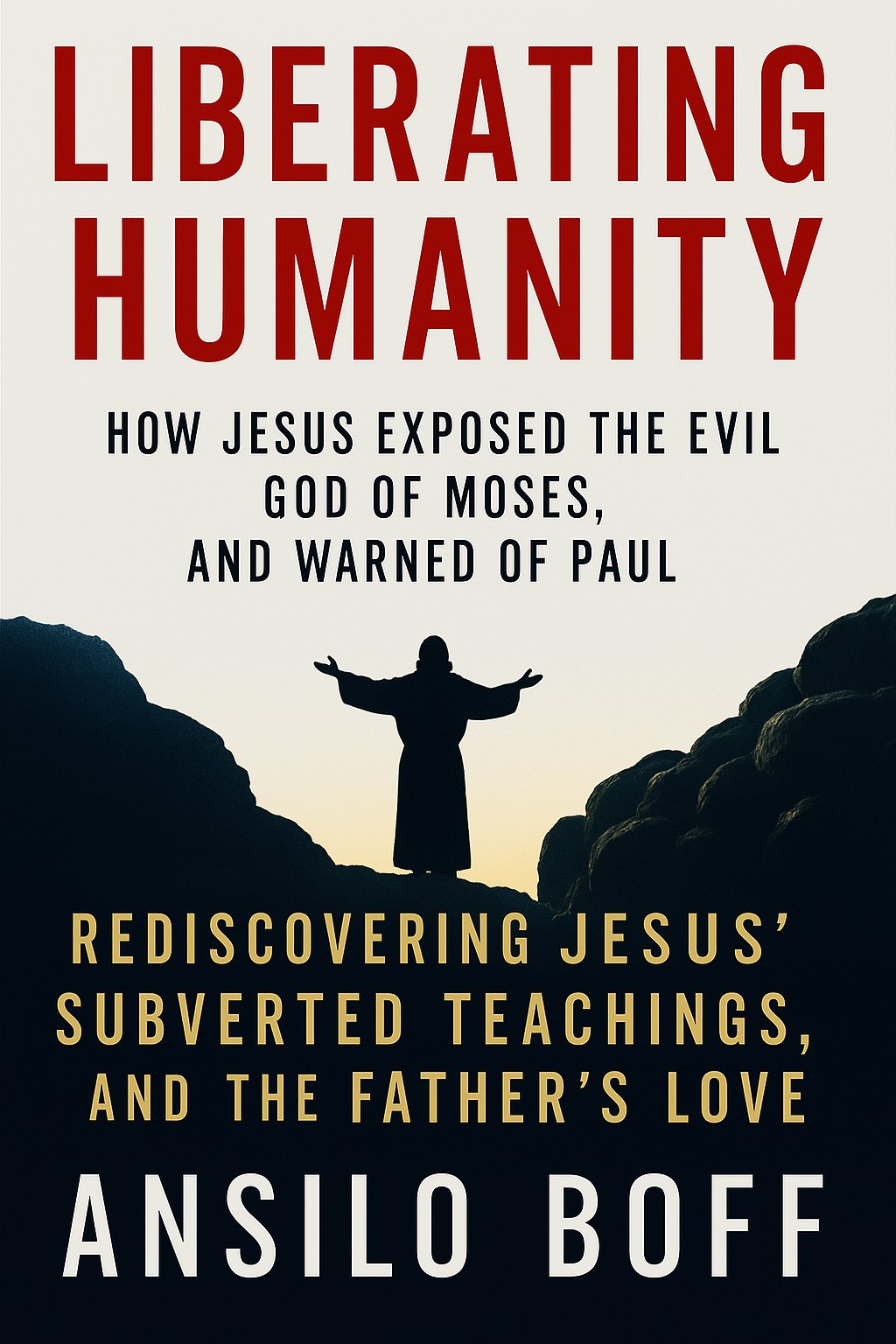
This article explores themes from "Escape the Hell Myth: Rediscover The Teachings Of Jesus On Love" and "Liberating Humanity: How Jesus Exposed The Evil God Of Moses And Warned Of Paul" by Ansilo Boff. For a comprehensive examination of these ideas with full scriptural evidence, linguistic analysis, and deeper exploration, read the full books.