Contradiction Number 10
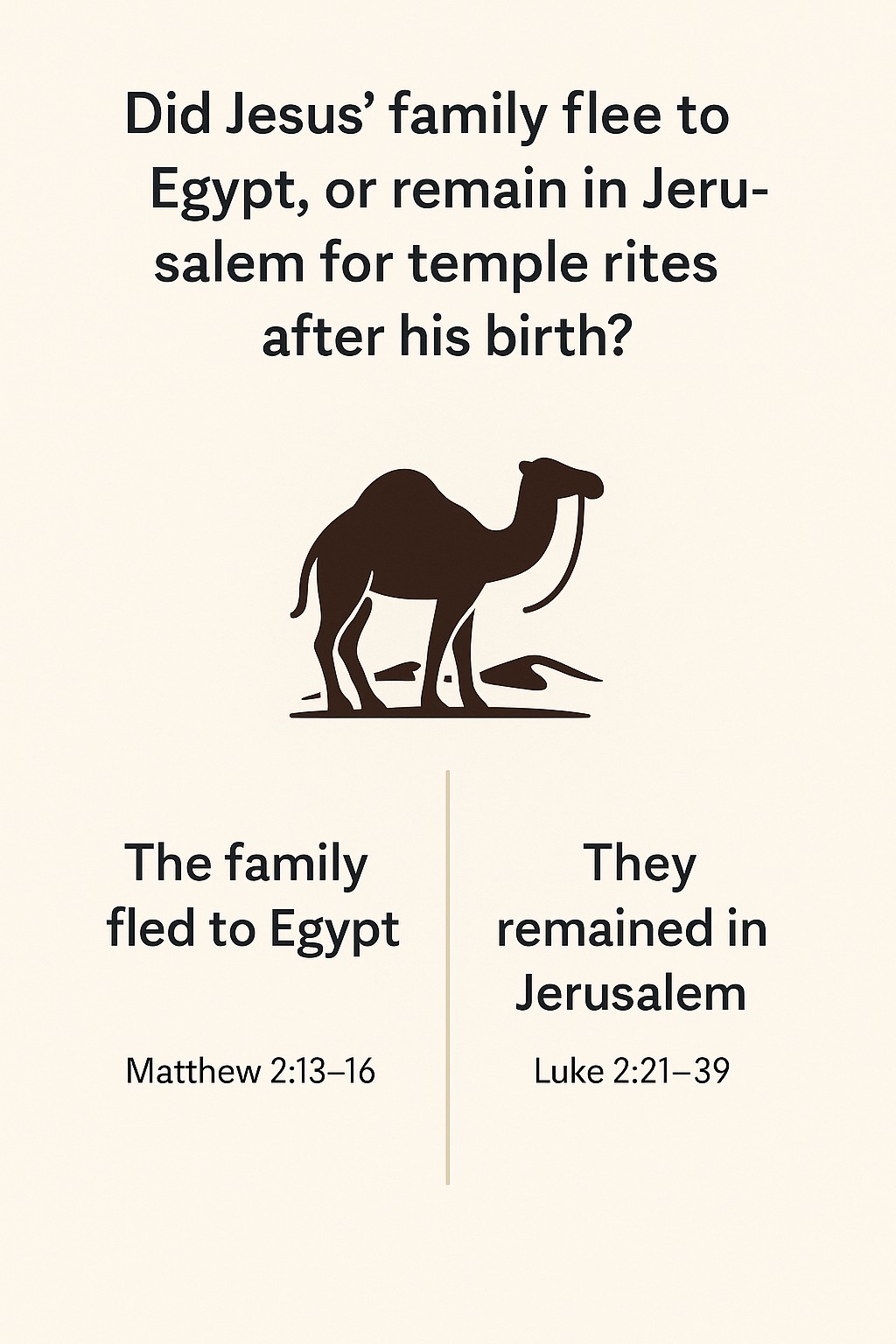
This contradiction shows up when you compare how Matthew and Luke describe what happened right after Jesus was born.
In Matthew 2:13-16, Joseph is warned in a dream to flee to Egypt because Herod wants to kill the child. So the family takes off and stays there until Herod dies.
But Luke 2:21-39 tells a completely different story: after Jesus is born, the family goes to Jerusalem to perform temple purification rites, then returns peacefully to Nazareth—no Egypt, no warning, no massacre.
Theologically, this contradiction can be pretty significant. The flight to Egypt is often cited as a fulfillment of prophecy, which is what Matthew specifically states quoting Hosea 11:1:
Out of Egypt I called my son.
In context, Hosea is referring to Israel being brought out of Egypt during the Exodus—not a future Messiah. It's a historical reference, not a predictive prophecy.
However, Matthew reinterprets it typologically, presenting Jesus as a new Israel or a new Moses, re-living Israel's journey. This approach—using typology rather than strict prediction—is common in Matthew's Gospel and is part of a broader strategy to show Jesus as the fulfillment of Hebrew scripture, sometimes in ways that reframe the original meaning.
Luke's version emphasizes Jewish law and ritual purity.
Trying to explain it away, some suggest the family first went to Jerusalem, then fled to Egypt, and later returned to Nazareth—but Luke's account implies a smooth, uninterrupted return from the temple.
The two stories don't just differ—they follow completely incompatible timelines, suggesting either a major omission in one Gospel or an irreconcilable narrative tension between them.